

Dragons and the experimental team that bought history to life
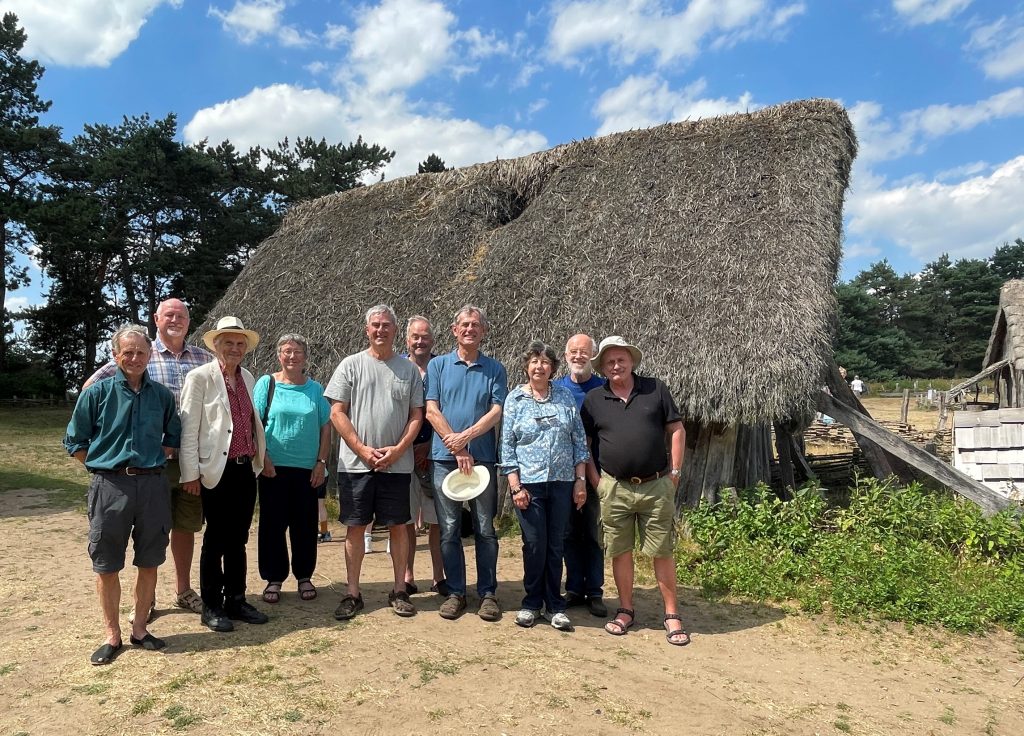
Hugh Darrah, Ian Shipp, Kimberley Rew, Rosemary Boughton, Ian Alister, Andy Wilson, Cliff Waterman, Liz Pieksma, Martin Jones and Alan Armer outside the oldest house at West Stow Anglo-Saxon Village. The team started work on the house on June 25, 1973, and returned on the 50th anniversary as part of the Dragon Fest event. Photo: West Suffolk Council.
There were more than dragons to entertain at West Stow as 50 years to the day reconstruction of the Anglo-Saxon Village began, with the team behind it returning.
Organised by West Suffolk Council, the two-day Dragon Fest saw more 2,200 people descend on the West Stow Anglo-Saxon Village at the weekend.
Ian Shipp, cabinet member for Leisure and Culture at West Suffolk, said: “The Anglo-Saxon Village hosts thousands of school children every year, bringing Anglo-Saxon history to life. As with many other cultures, the Anglo-Saxon believed dragons existed and you can see it illustrated in their art and storytelling on display at West Stow.
“Over a millennia later, dragons are still part of our story telling and our culture whether its St George, Harry Potter, The Hobbit or Game of Thrones. Dragon Fest is a wonderful day out for families and a great way to give young children a fun insight into the lives of the Anglo-Saxons.”
On Sunday, the event was joined by Ian Alister and others from the original team who on June 25, 1973, set about building the first reconstruction of an Anglo-Saxon pit houses.
To make it even more authentic they tasked themselves to only use the tools and materials that would have been available to the Anglo-Saxons. Not only that, they also built it on site of where remains of an Anglo-Saxon home had been discovered.
The team coppiced ash and hazel to form the rafters, purlins and interweave in the roof and an entire cow carcass was soaked in the River Lark, then stripped and dried to create lashing to secure the wooden joints.
With the first building completed by August 1973, the team went on to build two more.
Alan Armer, a freelance archaeologist who was involved in the dig on the site from 1969 to 1972 returned in the early 1980s and was in charge of the reconstruction of the rest of the Anglo-Saxon village.
Today the original oldest house still stands alongside seven other reconstructed buildings including a farmer’s house, craft building, hall, workshop and weaving house.
Cliff Waterman worked as an English teacher in nearby Suffolk schools before becoming a councillor.
Now leader of West Suffolk Council, together with councillor Shipp, they were at West Stow on Sunday to meet the team.
“The Anglo-Saxon village and the experiment this small team undertook all those years ago, is a key part of that tapestry of history and heritage that makes West Suffolk such a wonderful and attractive place to live and work. It was fascinating to meet them and to hear how it began all those years ago. We are very thankful for their experiment which has helped bring history to life for all those who visit this amazing site,” said councillor Waterman.