

Live facial recognition technology helps officers make arrests across Suffolk
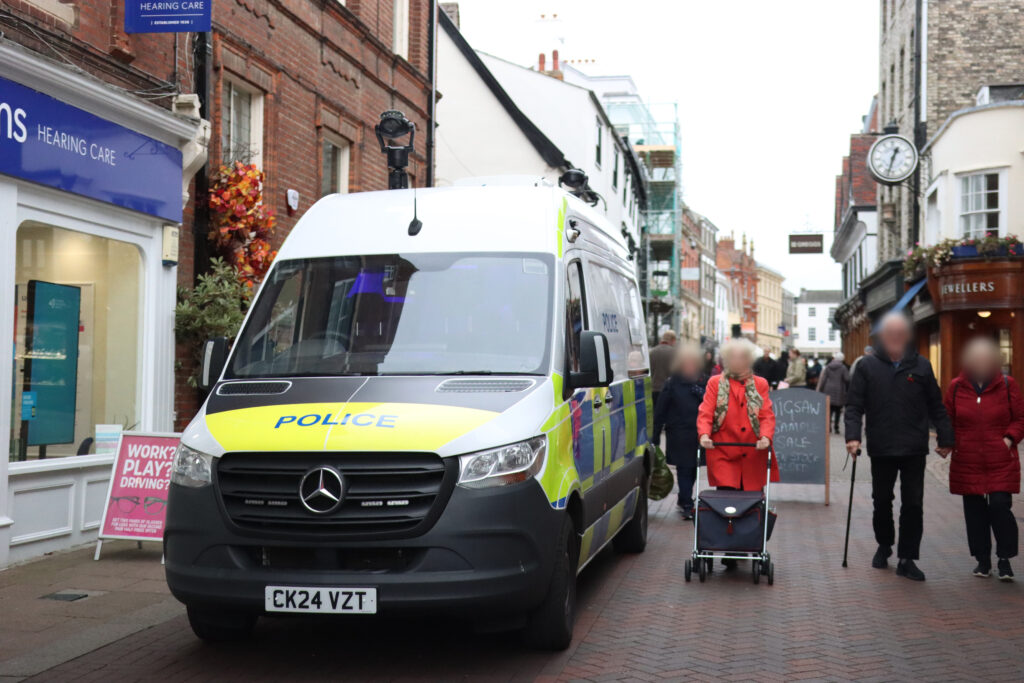
The live facial recognition technology day in Bury St Edmunds. Photo: Suffolk Constabulary.
Live facial recognition (LFR) technology has helped police support a number of arrests during recent deployments in Bury St Edmunds, Ipswich and Lowestoft.
The deployments took place between November 3 and 5 and formed part of the force’s ongoing use of the technology to locate people who are wanted by police in connection with criminal investigations.
Across the three deployments, officers used watchlists containing a total of more than 2,500 individuals and the technology scanned more than 64,000 faces in public spaces. The deployments resulted in four accurate alerts and no incorrect alerts being generated.
In Bury St Edmunds, officers deployed LFR using a watchlist of 880 individuals. The system scanned 26,033 faces and generated one positive alert but no arrest was deemed necessary as the suspect was adhering to his sexual harm prevention order.
In Ipswich, a watchlist of 907 individuals was used and 29,120 faces were seen by the technology. One positive alert contributed to police activity that resulted in four people being dealt with for offences including sexual assault, affray, failing to appear at court and a person being reported for theft.
In Lowestoft, a watchlist containing 768 individuals was used and 9,147 faces were seen by the system. Two positive alerts led officers to individuals wanted in connection with a breach of a Sexual Harm Prevention Order (SHPO) and theft from a shop, resulting in two arrests.
The deployments were staffed by officers from the west and south town centre teams.
Sgt Anthony Welford who oversaw the deployments and is based with the West Town Centre team, said: “Live facial recognition continues to prove its value as a policing tool by helping us locate people we are actively seeking and enabling officers to take swift and proportionate action.
“Thousands of people passed through the areas where the technology was in operation and, from more than 64,000 faces seen, every alert generated was accurate, with no incorrect alerts recorded. Images of individuals who do not generate an alert are automatically and immediately deleted and are not retained.
“The technology helps us protect communities, locate wanted individuals more quickly and make Suffolk safer while operating within a clear legal and ethical framework. It was also very encouraging to see the public expressing curiosity and approaching us during the deployments to learn and understand more about the technology.
“Plenty of the public took the time to look inside the van and see the system in action with virtually everyone, bar a couple of exceptions, very receptive and positive. We also express our thanks to Bedfordshire police for their loan of the van and equipment.”
Tim Passmore, Police and Crime Commissioner for Suffolk, added: “Anything that helps prevent crime, protect businesses and residents and bring criminals to justice is something I welcome.
“As technology continues to develop, it is important that policing embraces innovation where it can demonstrably improve public safety and deliver better outcomes for the people of Suffolk.”
“The vast majority of people in Suffolk are law-abiding citizens and should be reassured that images of those who are not the subject of police interest are immediately deleted and not retained.
“Our communities rightly expect the police to use every available tool to tackle criminality, support victims and keep people safe.
“Live Facial Recognition offers another way of achieving that, while helping officers focus their time where it is needed most.”